 PounceFit
Jackson & Pollock 7-Site Skinfold Calculator: Body Fat Percentage
By PounceFit Team · Updated on
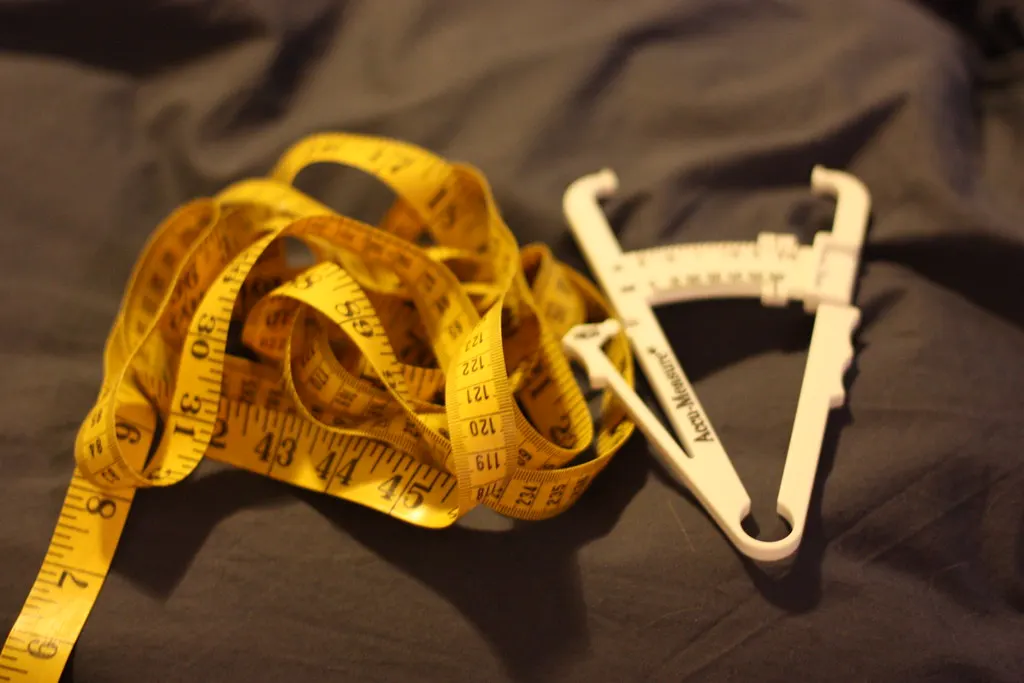
Technical content for health and fitness professionals. It reproduces formulas and protocols published in the scientific literature, with the sources at the end of the page. It is not a recommendation and does not replace the judgment of the professional who runs the assessment.
Free Jackson & Pollock 7-site skinfold calculator: body fat percentage and fat-free mass, with the same math as PounceFit, the body assessment app.
The Jackson & Pollock 7-site skinfold calculator estimates body fat percentage from seven skinfolds and age. The equation calculates body density, and the Siri equation converts it to body fat percentage (Jackson and Pollock, 1978; Jackson, Pollock and Ward, 1980; Siri, 1961). The math is the same as in PounceFit, body assessment software, and you can record the measurements on the printable body assessment form.
Who it is for
Adults from the general population. The equations were developed with men aged 18 to 61 and women aged 18 to 55 (Jackson and Pollock, 1978; Jackson, Pollock and Ward, 1980). Both sexes use the same seven sites: chest, midaxillary, triceps, subscapular, abdominal, suprailiac and thigh.
Formula
S = sum of the seven skinfolds, in mm.
- Men: density = 1.112 − 0.00043499 × S + 0.00000055 × S² − 0.00028826 × age
- Women: density = 1.097 − 0.00046971 × S + 0.00000056 × S² − 0.00012828 × age
- Body fat (%) = (4.95 ÷ density − 4.50) × 100
- Fat mass (kg) = body mass × body fat ÷ 100; fat-free mass = body mass − fat mass
Worked example
Woman, 28 years old, 62 kg (137 lb). Skinfolds (mm): chest 8, midaxillary 10, triceps 18, subscapular 13, abdominal 20, suprailiac 15, thigh 26.
- S = 110 mm; S² = 12,100.
- Density = 1.097 − 0.00046971 × 110 + 0.00000056 × 12,100 − 0.00012828 × 28 = 1.0485161.
- Body fat = (4.95 ÷ 1.0485161 − 4.50) × 100 = 22.1%.
- Fat mass = 13.7 kg; fat-free mass = 48.3 kg.
Limitations
- The result is an estimate. Skinfold equations have an error of about 3 to 4 percentage points against the reference method (Heyward and Wagner, 2004).
- Outside the age ranges and populations they were developed in, accuracy may be lower (Heyward and Wagner, 2004).
- Measurement technique matters a lot. Use the standardized sites (ACSM, 2021) and keep the same assessor and the same caliper at every reassessment.
- For a detailed look at the protocol, with a table of the measurement sites, see the article on the Jackson & Pollock 7-site skinfold protocol.
Sources
- Jackson AS, Pollock ML. Generalized equations for predicting body density of men. British Journal of Nutrition. 1978;40(3):497-504. doi:10.1079/BJN19780152
- Jackson AS, Pollock ML, Ward A. Generalized equations for predicting body density of women. Medicine and Science in Sports and Exercise. 1980;12(3):175-181.
- Siri WE. Body composition from fluid spaces and density: analysis of methods. In: Brožek J, Henschel A, editors. Techniques for measuring body composition. Washington: National Academy of Sciences; 1961. p. 223-244.
- Heyward VH, Wagner DR. Applied body composition assessment. 2nd ed. Champaign: Human Kinetics; 2004.
- American College of Sports Medicine. ACSM's guidelines for exercise testing and prescription. 11th ed. Philadelphia: Wolters Kluwer; 2021.