 PounceFit
 PT
 EN

Technical content for health and fitness professionals. It reproduces formulas and protocols published in the scientific literature, with the sources at the end of the page. It is not a recommendation and does not replace the judgment of the professional who runs the assessment.
Waist circumference and the waist-hip ratio indicate abdominal fat, which BMI does not show. The most widely used cutoffs, attributed to WHO, indicate increased risk of metabolic complications with a waist above 94 cm in men and 80 cm in women, and substantially increased risk above 102 cm and 88 cm. By waist-hip ratio, risk is substantially increased from 0.90 in men and 0.85 in women (WHO, 2011). They are references for risk screening in adults, not a diagnosis. To run the numbers, use the waist-hip ratio calculator.
What are the WHO cutoffs for the waist?
| Indicator | Men | Women | Risk of metabolic complications |
|---|---|---|---|
| Waist circumference | Above 94 cm | Above 80 cm | Increased |
| Waist circumference | Above 102 cm | Above 88 cm | Substantially increased |
| Waist-hip ratio | 0.90 or more | 0.85 or more | Substantially increased |
Source: WHO (2011, table A1).
Where the 94 and 80 cm values come from
The 2011 WHO report explains that these values, although attributed to WHO, came from two earlier reports, and that the waist cutoffs cited in 2000 were an example, based on a Dutch sample of adults aged 20 to 59, not a formal recommendation (WHO, 2011). The same values of 94 and 80 cm and of 102 and 88 cm appear in Lean, Han and Morrison (1995), who tested them in 904 men and 1,014 women in Glasgow: waist at those points identified those with a high BMI or a high waist-hip ratio with sensitivity above 96%.
The 2008 consultation itself concluded that the evidence does not yet answer whether cutoffs should be specific by sex, age and population (WHO, 2011).
Do the cutoffs change with ethnicity?
The International Diabetes Federation uses waist cutoffs by population (WHO, 2011, table A2):
| Population | Men | Women |
|---|---|---|
| Europeans | Above 94 cm | Above 80 cm |
| South Asians, Chinese and Japanese | Above 90 cm | Above 80 cm |
The 2009 joint statement on the metabolic syndrome unified the criteria for the other components, but not for the waist: until there are more studies, it accepts national or regional cutoffs (Alberti et al., 2009).
How to measure the waist and hip
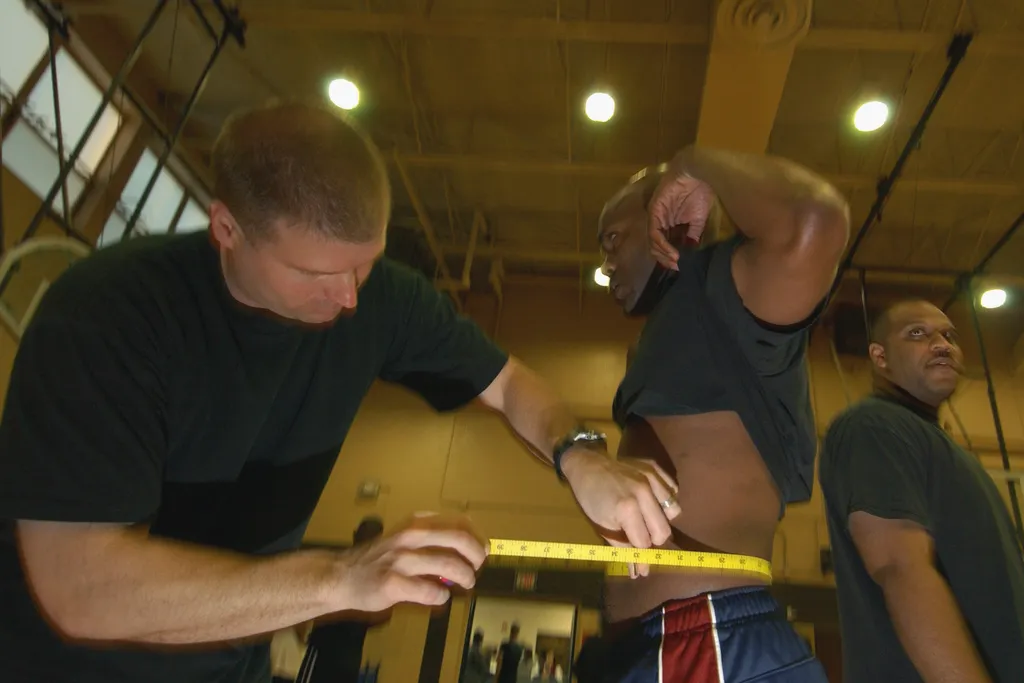
The WHO cutoffs assume measurement by the WHO's own standard (WHO, 2011):
- Waist: at the midpoint between the lower margin of the last palpable rib and the top of the iliac crest, with a non-stretch tape at constant tension.
- Hip: at the widest part of the buttocks, with the tape parallel to the floor.
ISAK measures the waist at the narrowest point between the lower costal border (10th rib) and the top of the iliac crest (Stewart et al., 2011). Measuring at a different site changes the value and the comparison with the cutoff. Record which standard was used and repeat the same one at reassessments. The technique for each girth is in body circumferences.
How to calculate the waist-hip ratio
Waist-hip ratio = waist circumference ÷ hip circumference
A man, waist of 98 cm and hip of 104 cm, measured by the WHO standard.
- Waist-hip ratio = 98 ÷ 104 = 0.94.
- By the ratio: 0.94 is above 0.90, substantially increased risk.
- By the waist: 98 cm is above 94 cm and below 102 cm, increased risk.
The two readings do not have to match. The result is risk information for the assessment, not a diagnosis.
Why measure the waist in addition to BMI?
A 2020 international consensus argues that the waist adds information to BMI in predicting disease and death and proposes that it be measured as a vital sign in clinical practice, with trained professionals taking the measurement correctly (Ross et al., 2020). The calculation and limits of BMI are in how to calculate BMI, and estimating fat with only a tape measure is in the body fat from circumferences calculator.
The waist and hip are on the printable body assessment form and, in PounceFit, on the circumferences tab of each assessment.
Frequently asked questions
What is the ideal waist circumference?
The most widely used cutoffs, attributed to WHO, indicate increased risk of metabolic complications above 94 cm (37 in) in men and 80 cm (31.5 in) in women, and substantially increased risk above 102 cm (40 in) and 88 cm (35 in) (WHO, 2011). They are values set with European populations and are not an aesthetic goal.
How do I calculate the waist-hip ratio?
Divide the waist circumference by the hip circumference, both in the same unit. A waist of 84 cm and a hip of 100 cm give 84 ÷ 100 = 0.84. By the cutoffs attributed to WHO, risk is substantially increased from 0.90 in men and 0.85 in women (WHO, 2011).
Where should I measure the waist?
To use the WHO cutoffs, at the midpoint between the lower margin of the last palpable rib and the top of the iliac crest, with a non-stretch tape, at the end of a normal exhalation. The hip is measured at the widest part of the buttocks, with the tape parallel to the floor (WHO, 2011). ISAK measures the waist at the narrowest point (Stewart et al., 2011).
Are the cutoffs the same for all ethnicities?
Not necessarily. The International Diabetes Federation uses 94 cm for European men and 80 cm for European women, and 90 cm for South Asian, Chinese and Japanese men (WHO, 2011). The joint statement on the metabolic syndrome left waist circumference without a single cutoff and accepts national or regional cutoffs until there is consensus (Alberti et al., 2009).
Sources
- World Health Organization. Waist circumference and waist-hip ratio: report of a WHO expert consultation, Geneva, 8-11 December 2008. Geneva: WHO; 2011.
- Lean ME, Han TS, Morrison CE. Waist circumference as a measure for indicating need for weight management. BMJ. 1995;311(6998):158-161. doi:10.1136/bmj.311.6998.158
- Alberti KG, Eckel RH, Grundy SM, Zimmet PZ, Cleeman JI, Donato KA, et al. Harmonizing the metabolic syndrome: a joint interim statement of the International Diabetes Federation Task Force on Epidemiology and Prevention; National Heart, Lung, and Blood Institute; American Heart Association; World Heart Federation; International Atherosclerosis Society; and International Association for the Study of Obesity. Circulation. 2009;120(16):1640-1645. doi:10.1161/CIRCULATIONAHA.109.192644
- Ross R, Neeland IJ, Yamashita S, Shai I, Seidell J, Magni P, et al. Waist circumference as a vital sign in clinical practice: a Consensus Statement from the IAS and ICCR Working Group on Visceral Obesity. Nature Reviews Endocrinology. 2020;16(3):177-189. doi:10.1038/s41574-019-0310-7
- Stewart A, Marfell-Jones M, Olds T, de Ridder H. International standards for anthropometric assessment. Lower Hutt: International Society for the Advancement of Kinanthropometry; 2011.