 PounceFit
 PT
 EN

Technical content for health and fitness professionals. It reproduces formulas and protocols published in the scientific literature, with the sources at the end of the page. It is not a recommendation and does not replace the judgment of the professional who runs the assessment.
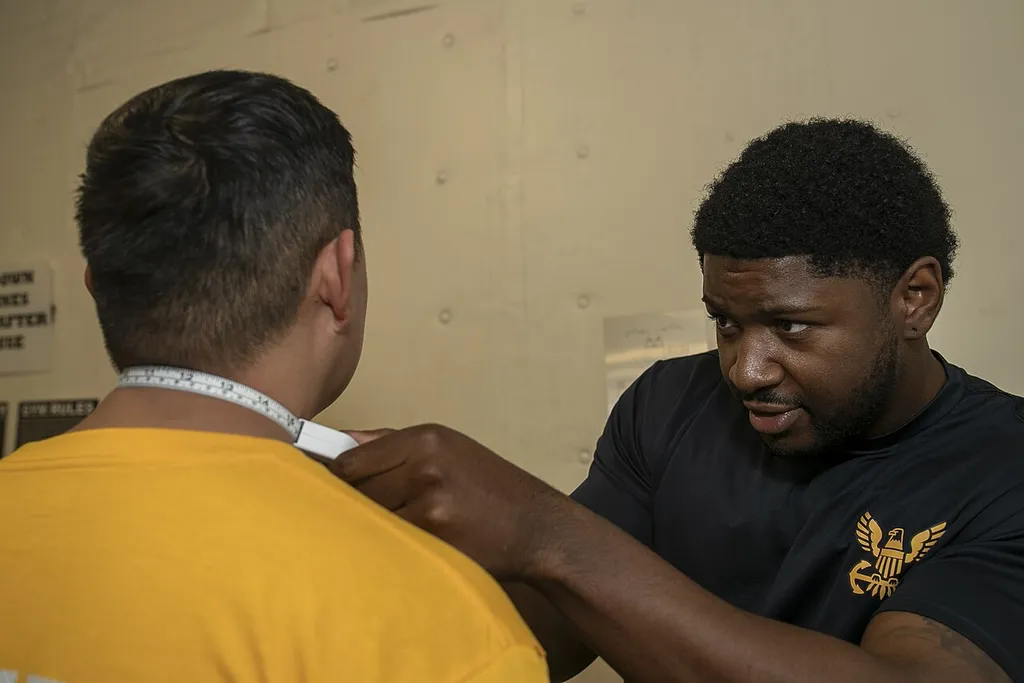
The body fat from circumferences calculator estimates body fat percentage with a measuring tape, using the US Navy method (Hodgdon and Beckett, 1984). Men measure neck and waist; women also measure the hip. With height, the equations calculate body density, which the Siri equation converts to body fat (Siri, 1961). This version uses measurements in centimeters. With body mass, the calculator also shows fat mass and fat-free mass.
Who it is for
Adults, when there are no calipers or when a quick assessment with only a measuring tape is wanted. The equations were developed with US Navy personnel (Hodgdon and Beckett, 1984), so accuracy may be lower in very different groups, such as older adults and athletes. The measurement technique is in body circumferences.
Formula
Measurements in cm, log base 10.
- Men: body fat (%) = 495 ÷ (1.0324 - 0.19077 × log(waist - neck) + 0.15456 × log(height)) - 450
- Women: body fat (%) = 495 ÷ (1.29579 - 0.35004 × log(waist + hip - neck) + 0.22100 × log(height)) - 450
The denominator is the estimated body density; "495 ÷ density - 450" is the Siri equation (1961).
Worked example
Man, 1.78 m, neck 38 cm, waist 85 cm, 80 kg.
- Waist - neck = 47 cm. log(47) = 1.67210.
- log(178) = 2.25042.
- Density = 1.0324 - 0.19077 × 1.67210 + 0.15456 × 2.25042 = 1.06124.
- Body fat = 495 ÷ 1.06124 - 450 = 16.4%.
- Fat mass = 80 × 0.164 = 13.1 kg; fat-free mass = 66.9 kg.
Limitations
- It is an indirect estimate: the equations were fitted against density measured by hydrostatic weighing (Hodgdon and Beckett, 1984) and carry the error of that prediction.
- Waist and neck vary with breathing and posture. Follow the standardized technique (Stewart and colleagues, 2011) and use the same site at every assessment.
- The result cannot be compared with skinfold or bioimpedance results. To track a client, keep the same method.
If you have calipers, use the Jackson and Pollock 3-site calculator; for waist-based risk, the waist-hip ratio calculator. The result can be read against the ranges in ideal body fat percentage by sex and age, and the measurements can be written down on the body assessment form in PDF.
Frequently asked questions
Why do women need to measure the hip?
Because the Navy equation for women uses waist plus hip minus neck, while the one for men uses only waist minus neck (Hodgdon and Beckett, 1984). Without the hip, the calculator cannot estimate body fat for women.
Is the Navy method as good as skinfolds?
Both are indirect estimates, each with its own error against the reference method. The advantage of the circumference method is that it needs only a measuring tape. Do not compare the result of one method with the other: pick one and always use the same one with the client.
Where do I measure the neck and the waist?
Follow one standard and repeat it at every assessment. The tape sits perpendicular to the segment, on the skin without compressing the tissue, with the reading taken at the end of a normal expiration for trunk measurements (Stewart and colleagues, 2011). Record the waist site you used.
Sources
- Hodgdon JA, Beckett MB. Prediction of percent body fat for U.S. Navy men from body circumferences and height. Report No. 84-11. San Diego: Naval Health Research Center; 1984.
- Hodgdon JA, Beckett MB. Prediction of percent body fat for U.S. Navy women from body circumferences and height. Report No. 84-29. San Diego: Naval Health Research Center; 1984.
- Siri WE. Body composition from fluid spaces and density: analysis of methods. In: Brožek J, Henschel A, editors. Techniques for measuring body composition. Washington: National Academy of Sciences; 1961. p. 223-244.
- Stewart A, Marfell-Jones M, Olds T, de Ridder H. International standards for anthropometric assessment. Lower Hutt: International Society for the Advancement of Kinanthropometry; 2011.