 PounceFit
 PT
 EN

Technical content for health and fitness professionals. It reproduces formulas and protocols published in the scientific literature, with the sources at the end of the page. It is not a recommendation and does not replace the judgment of the professional who runs the assessment.
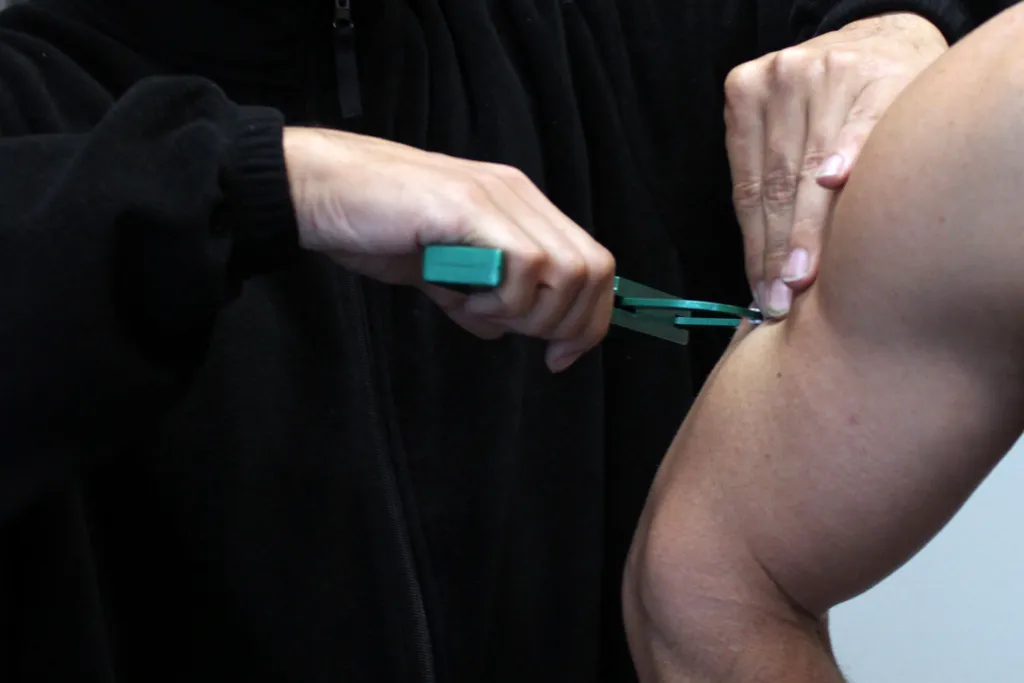
To measure a skinfold, mark the anatomical site with a pen, pinch the skin and the fat just beneath it between thumb and index finger without taking muscle, apply the caliper 1 cm from the fingers, at 90° to the skinfold, and read 2 seconds after full pressure. Measure on the right side, two or three times in rotation through the sites, and use the mean of two or the median of three (Norton, 2018). The exact site changes with the standard adopted, ISAK or ACSM, and must be the same as in the protocol of the equation.
The values then go into an equation, such as the Jackson and Pollock 7-site, or are used directly as the sum of skinfolds to track progress.
What to check before measuring
- Calibrated caliper. Check the zero before starting and verify the jaw opening with a vernier caliper. ISAK recommends yearly calibration, because the spring loses tension over time (Norton, 2018).
- Same caliper. Applying skinfolds from a different caliper than the one used in the original study to an equation calls for caution (Norton, 2018).
- Timing. Do not measure right after training, sauna, swimming or a hot shower: the increased blood flow to the skin increases the skinfold (Norton, 2018).
- Setting. A room at a comfortable temperature, clothing that gives access to the sites, and respect for the privacy and preferences of the person assessed, including about the assessor's sex (Norton, 2018).
How to pinch the skinfold and read the caliper
According to the ISAK standard, as described by Norton (2018):
- Locate and mark the site with a dermographic pen, from the bony landmarks. Placing the caliper even a few centimeters away from the correct site changes the thickness measured.
- Pinch the skinfold between thumb and index finger, with the back of the hand facing the assessor, taking the double layer of skin and the subcutaneous fat. Roll the fingers slightly to release the muscle. If in doubt, ask the person to contract the muscle and then relax.
- Apply the caliper with the edge of the tips 1 cm from the fingers, at a depth of about half the fingernail, at 90° to the skin surface.
- Keep the skinfold held with the hand throughout the reading.
- Read at 2 seconds after the caliper applies full pressure. The fingers on the trigger must not hold back the spring.
- Rotate: measure all sites once, then repeat the sequence. With two measurements, use the mean; with three, the median.
The ACSM (2021) describes the same logic: right side, caliper perpendicular to the skinfold and repeated measurements in rotation, redoing the site when the two readings differ too much.
Anatomical sites of the skinfolds (ISAK)
ISAK uses eight skinfolds in the restricted profile (Norton, 2018). All on the right side:
| Skinfold | Site | Direction of the fold |
|---|---|---|
| Triceps | Posterior surface of the arm, on the midline, at the level of the midpoint between the acromion and the head of the radius | Parallel to the long axis of the arm |
| Subscapular | 2 cm below the inferior angle of the scapula, on a line running 45° downward and outward | Oblique, at 45°, following the natural skin lines |
| Biceps | Anterior surface of the arm, at the middle of the biceps, at the same level as the triceps | Parallel to the long axis of the arm |
| Iliac crest | Just above the iliac crest, on the line that descends from the armpit | Slightly inclined forward and downward |
| Supraspinale | Intersection of the line from the anterior superior iliac spine to the anterior axillary border with the horizontal at the level of the iliac crest | Inward and downward, at about 45° |
| Abdominal | 5 cm to the right of the center of the navel | Vertical |
| Front thigh | Midpoint between the inguinal crease and the proximal border of the patella, with the person seated and the knee at 90° | Parallel to the long axis of the thigh |
| Medial calf | Medial surface of the leg, at the level of the maximum circumference | Vertical |
The ISAK iliac crest skinfold corresponds to the suprailiac described by Durnin and Womersley; the supraspinale corresponds to the old suprailiac of Heath and Carter (Norton, 2018). Identical names in different protocols do not always indicate the same site.
Skinfold sites in the ACSM
The ACSM (2021) describes the sites used in the Jackson and Pollock equations, also on the right side and with the person standing:
| Skinfold | Direction | Site |
|---|---|---|
| Chest | Diagonal | Men: half the distance between the anterior axillary line and the nipple. Women: one third of that distance, from the axillary line |
| Midaxillary | Vertical | Midaxillary line, at the level of the xiphoid process |
| Triceps | Vertical | Posterior surface of the arm, at the midpoint between the acromion and the olecranon |
| Subscapular | Diagonal (about 45°) | 1 to 2 cm below the inferior angle of the scapula |
| Abdominal | Vertical | 2 cm to the right of the navel |
| Suprailiac | Diagonal | Just above the iliac crest, on the anterior axillary line |
| Thigh | Vertical | Anterior surface, at the midpoint between the inguinal crease and the proximal border of the patella |
Common errors in skinfold measurement
- Misplaced site. This is the most frequent source of error. Mark the site with a pen, especially early in practice (Norton, 2018).
- Mixing standards. Measuring the abdominal at 5 cm (ISAK) and applying it to an equation made with the abdominal at 2 cm (ACSM) changes the result. Use the site from the equation's protocol.
- Taking muscle. The skinfold must contain only skin and fat. Roll the fingers before applying the caliper (Norton, 2018).
- Caliper too deep or too shallow. Away from the half-fingernail depth, the value changes (Norton, 2018).
- Reading too early or too late. Without the fixed 2-second time, tissue compression changes the reading (Norton, 2018).
- Measuring the same site back to back. If consecutive readings keep dropping, the tissue is being compressed. Move on to the next site and come back after a few minutes (Norton, 2018).
- Large skinfolds. Error tends to be greater where there is more fat, such as the suprailiac and abdomen. An assistant who holds the skinfold with both hands can help (Perini et al., 2005).
To know whether your technique is good, calculate your technical error of measurement: it is the standard way to measure an assessor's repeatability (Perini et al., 2005).
Measurements in PounceFit
In PounceFit, body assessment software for personal trainers, each skinfold gets two measurements and the app calculates the mean. To record on paper, the printable body assessment form has the skinfold fields.
Frequently asked questions
How long should I wait before reading the caliper?
In the ISAK standard, the reading is taken 2 seconds after the caliper applies full pressure, even if the needle is still moving on large skinfolds. The fixed time exists because adipose tissue compresses, and only then are repeated measurements comparable (Norton, 2018).
How many times should I measure each skinfold?
Two or three times, in rotation through the sites, and not back to back at the same site. With two measurements, use the mean; with three, the median (Norton, 2018).
Which side of the body should I measure?
The right, in both the ISAK and the ACSM standards, regardless of the dominant side (Norton, 2018; ACSM, 2021). If an injury prevents it, measure the left and note it on the record.
Is the abdominal skinfold 2 or 5 cm from the navel?
It depends on the standard. In the ACSM, the abdominal skinfold is vertical, 2 cm to the right of the navel (ACSM, 2021). In ISAK, it is 5 cm to the right of the center of the navel (Norton, 2018). Use the site described by the protocol of the equation you will apply and keep the same one at reassessments.
Can I measure right after training?
It is not recommended. Training, sauna, swimming and hot showers increase blood flow to the skin and the thickness of the skinfold (Norton, 2018). Measure before training.
Sources
- Norton KI. Standards for anthropometry assessment. In: Norton K, Eston R, editors. Kinanthropometry and exercise physiology. 4th ed. London: Routledge; 2018. p. 68-137. doi:10.4324/9781315385662-4
- Stewart A, Marfell-Jones M, Olds T, de Ridder H. International standards for anthropometric assessment. Lower Hutt: International Society for the Advancement of Kinanthropometry; 2011.
- American College of Sports Medicine. ACSM's guidelines for exercise testing and prescription. 11th ed. Philadelphia: Wolters Kluwer; 2021.
- Perini TA, Oliveira GL, Ornellas JS, Oliveira FP. Cálculo do erro técnico de medição em antropometria. Revista Brasileira de Medicina do Esporte. 2005;11(1):81-85. doi:10.1590/S1517-86922005000100009