 PounceFit
 PT
 EN

Technical content for health and fitness professionals. It reproduces formulas and protocols published in the scientific literature, with the sources at the end of the page. It is not a recommendation and does not replace the judgment of the professional who runs the assessment.
The 1RM calculator estimates the one-repetition maximum load from a set taken to failure: you enter the load and the number of repetitions (1 to 10) and it returns four estimates, from the PounceFit table and from the Lombardi (1989), Brzycki (1993) and Epley (1985) equations. The "PounceFit (table)" line is the same math as in PounceFit, body assessment app for personal trainers. The equations are less error-prone with few repetitions (Reynolds, Gordon and Robergs, 2006).
Who it is for
Clients for whom a direct 1RM test is not the best choice, such as beginners, older adults and people who should not do maximal effort. When the client has experience and technique, the direct test remains the reference (ACSM, 2021). Full details are in the article on estimating 1RM.
Formula
C is the load lifted (kg) and R the number of complete repetitions to failure.
- Lombardi (exponential): 1RM = C × R^0.10
- Brzycki: 1RM = C × 36 ÷ (37 - R)
- Epley: 1RM = C × (1 + R ÷ 30)
- PounceFit (table): 1RM = C × table coefficient
| Repetitions | 1 | 2 | 3 | 4 | 5 | 6 | 7 | 8 | 9 | 10 |
|---|---|---|---|---|---|---|---|---|---|---|
| Table coefficient | 1.00 | 1.07 | 1.10 | 1.13 | 1.16 | 1.20 | 1.23 | 1.27 | 1.32 | 1.36 |
The table coefficients do not match Lombardi's exponential form: they are close up to 8 repetitions and higher at 9 and 10.
Worked example
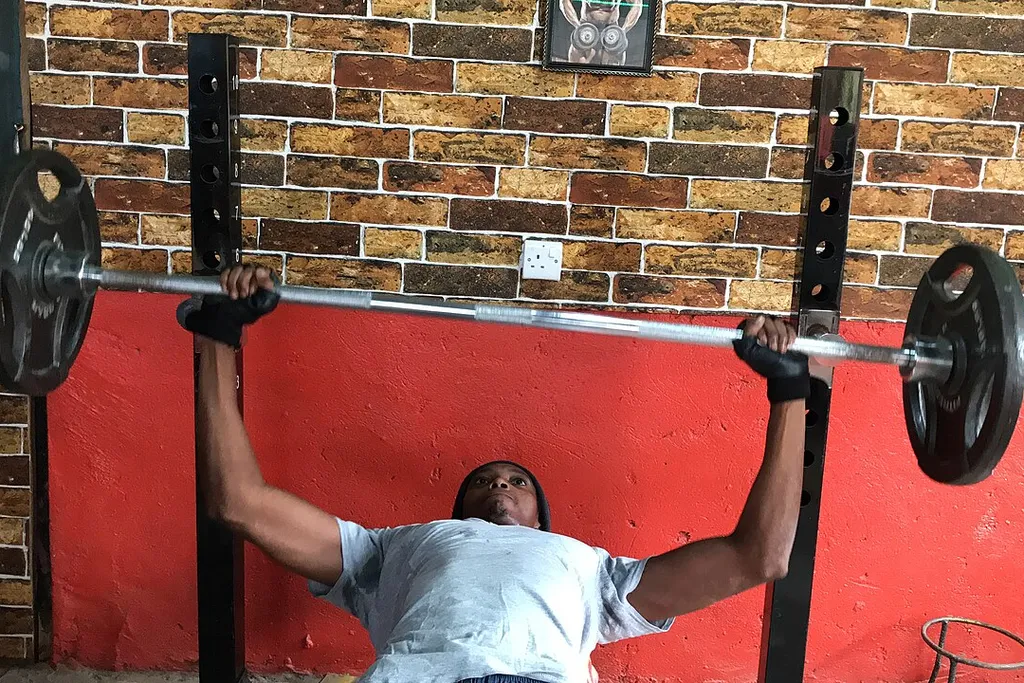
Bench press with 80 kg, 8 repetitions to failure.
- PounceFit (table): 80 × 1.27 = 101.6 kg.
- Lombardi (exponential): 8^0.10 = 1.2311. 80 × 1.2311 = 98.5 kg.
- Brzycki: 36 ÷ (37 - 8) = 1.2414. 80 × 1.2414 = 99.3 kg.
- Epley: 1 + 8 ÷ 30 = 1.2667. 80 × 1.2667 = 101.3 kg.
All four fall between 98.5 and 101.6 kg, a 3 kg difference just from the choice of equation.
Limitations
- The error changes from exercise to exercise. In the study by Reynolds, Gordon and Robergs (2006), the standard error of the authors' equation was about 3 kg for the bench press and 16 kg for the leg press from the 5RM.
- In university students with no resistance training experience, all the equations tested underestimated the deadlift (LeSuer and colleagues, 1997).
- Count only repetitions with full range of motion and maintained technique, and repeat the same exercise and equipment at reassessments.
For the aerobic part of the assessment, use the training heart rate calculator.
Frequently asked questions
Why does the calculator only accept up to 10 repetitions?
Because the equations get less accurate as the set gets longer. Reynolds, Gordon and Robergs (2006) concluded that sets should not go beyond 10 repetitions, and accuracy was better with a 5RM than with a 10RM.
Which of the four estimates should I use?
None wins in every exercise (LeSuer and colleagues, 1997; Reynolds, Gordon and Robergs, 2006). Pick one and always use the same one with the same client, exercise and equipment.
Why is the PounceFit line different from Lombardi's?
Because PounceFit multiplies the load by a table of coefficients, not by Lombardi's exponential form (repetitions raised to 0.10). Up to 8 repetitions the difference is small; at 9 and 10, the table gives higher values.
Sources
- Lombardi VP. Beginning weight training: the safe and effective way. Dubuque: W.C. Brown; 1989.
- Brzycki M. Strength testing: predicting a one-rep max from reps-to-fatigue. Journal of Physical Education, Recreation & Dance. 1993;64(1):88-90. doi:10.1080/07303084.1993.10606684
- Epley B. Poundage chart. In: Boyd Epley workout. Lincoln: Body Enterprises; 1985. p. 86.
- Reynolds JM, Gordon TJ, Robergs RA. Prediction of one repetition maximum strength from multiple repetition maximum testing and anthropometry. Journal of Strength and Conditioning Research. 2006;20(3):584-592. doi:10.1519/R-15304.1
- LeSuer DA, McCormick JH, Mayhew JL, Wasserstein RL, Arnold MD. The accuracy of prediction equations for estimating 1-RM performance in the bench press, squat, and deadlift. Journal of Strength and Conditioning Research. 1997;11(4):211-213.
- American College of Sports Medicine. ACSM's guidelines for exercise testing and prescription. 11th ed. Philadelphia: Wolters Kluwer; 2021.