 PounceFit
 PT
 EN

Technical content for health and fitness professionals. It reproduces formulas and protocols published in the scientific literature, with the sources at the end of the page. It is not a recommendation and does not replace the judgment of the professional who runs the assessment.
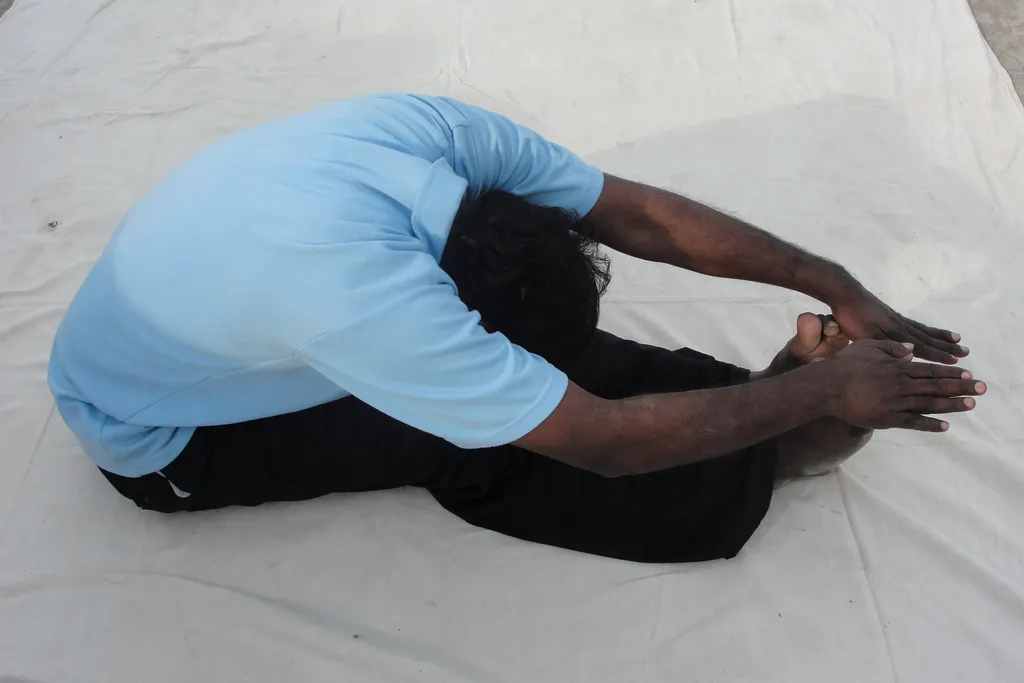
The sit-and-reach test measures how far a person can reach forward, seated with legs extended and feet against a box with a ruler, the Wells box. Created by Wells and Dillon (1952), it is now used mainly as an estimate of hamstring flexibility: in a meta-analysis, validity was moderate for the hamstrings (mean correlations of 0.46 to 0.67) and low for the lower back (0.16 to 0.35) (Mayorga-Vega et al., 2014). In the Canadian protocol reproduced by ACSM, two attempts are made and the best is recorded, in centimeters (ACSM, 2018).
How to run the sit-and-reach test
Canadian trunk forward flexion protocol, as described by ACSM (2018):
- Warm-up. A short warm-up, with a few stretches, without fast or jerky movements.
- No shoes. The client removes their footwear.
- Position. Seated, with the soles of the feet against the box and the inner edges of the feet about 15 cm apart. Knees stay extended, without the assessor pushing them down.
- Hands. Parallel, with fingertips overlapping, one hand not ahead of the other.
- Reach. Move forward slowly, as far as possible, and hold the position for about 2 seconds, without bouncing. Breathe normally; exhaling and letting the head drop between the arms helps.
- Attempts. Two, recording the best, in centimeters, at the farthest point reached by the fingertips.
Wells box reference table
Classification for adults, in centimeters, for a box with the feet at the 26 cm mark (Canadian Society for Exercise Physiology table reproduced by ACSM, 2018, table 7.1).
Men:
| Age | Excellent | Very good | Good | Fair | Needs improvement |
|---|---|---|---|---|---|
| 20 to 29 years | 40 or more | 34 to 39 | 30 to 33 | 25 to 29 | 24 or less |
| 30 to 39 years | 38 or more | 33 to 37 | 28 to 32 | 23 to 27 | 22 or less |
| 40 to 49 years | 35 or more | 29 to 34 | 24 to 28 | 18 to 23 | 17 or less |
| 50 to 59 years | 35 or more | 28 to 34 | 24 to 27 | 16 to 23 | 15 or less |
| 60 to 69 years | 33 or more | 25 to 32 | 20 to 24 | 15 to 19 | 14 or less |
Women:
| Age | Excellent | Very good | Good | Fair | Needs improvement |
|---|---|---|---|---|---|
| 20 to 29 years | 41 or more | 37 to 40 | 33 to 36 | 28 to 32 | 27 or less |
| 30 to 39 years | 41 or more | 36 to 40 | 32 to 35 | 27 to 31 | 26 or less |
| 40 to 49 years | 38 or more | 34 to 37 | 30 to 33 | 25 to 29 | 24 or less |
| 50 to 59 years | 39 or more | 33 to 38 | 30 to 32 | 25 to 29 | 24 or less |
| 60 to 69 years | 35 or more | 31 to 34 | 27 to 30 | 23 to 26 | 22 or less |
The box's zero point
Different Wells boxes have the ruler positioned differently relative to the feet. The table above assumes the foot line is at the 26 cm mark. If on your box the foot line is at 23 cm, subtract 3 cm from each table value before classifying (ACSM, 2018). Note on the form which box was used.
Worked example
A 34-year-old woman, box with the foot line at 23 cm.
- Two attempts: 30 cm and 32 cm. The best counts: 32 cm.
- Table adjustment for the 23 cm box: subtract 3 cm from each limit. For women aged 30 to 39, the "Very good" range goes from 36 to 40 to 33 to 37, and the "Good" range from 32 to 35 to 29 to 32.
- 32 cm falls in the "Good" range.
Another way, with the same result: add 3 cm to the measurement (32 + 3 = 35 cm) and use the original table. 35 cm is in "Good" (32 to 35).
Limits of the test
- It measures hamstrings more than the spine. Despite the original name, which refers to back and leg flexibility, validity for the lower back is low (Mayorga-Vega et al., 2014). For the lower back, the test does not replace an angular assessment.
- Body proportions. Arms and legs of different lengths change the reach without any change in flexibility.
- Box and protocol. Zero point, warm-up and number of attempts change the value. Repeat everything the same way at reassessment.
- Older adults. For people who find it hard to sit on the floor, the chair sit-and-reach is the validated alternative (Jones et al., 1998). See body assessment in older adults.
The test belongs in the testing stage of the complete body assessment, along with strength and aerobic capacity, such as the VO₂max field tests. PounceFit, body assessment software, organizes the assessment in tabs and compares two assessments side by side.
Frequently asked questions
What does the sit-and-reach test measure?
Mainly hamstring flexibility. In a meta-analysis of 34 studies, the validity of sit-and-reach tests was moderate for the hamstrings and low for the lower back (Mayorga-Vega et al., 2014).
How many attempts should I do?
Two, recording the best, in the Canadian trunk forward flexion protocol reproduced by ACSM (2018). Keep the same number of attempts at reassessments.
Why does my Wells box give different values from the table?
Because the zero point changes from one box to another. The Canadian table assumes the feet at the 26 cm mark. If your box has the feet at 23 cm, subtract 3 cm from each table value before comparing (ACSM, 2018).
Is there a version for older adults?
Yes, the chair sit-and-reach from the Senior Fitness Test. It had validity comparable to the floor test for measuring hamstring flexibility in older adults and is a safer alternative that they accept more readily (Jones et al., 1998).
Sources
- Wells KF, Dillon EK. The sit and reach: a test of back and leg flexibility. Research Quarterly. 1952;23(1):115-118. doi:10.1080/10671188.1952.10761965
- American College of Sports Medicine. ACSM's exercise testing and prescription. Philadelphia: Wolters Kluwer; 2018.
- Mayorga-Vega D, Merino-Marban R, Viciana J. Criterion-related validity of sit-and-reach tests for estimating hamstring and lumbar extensibility: a meta-analysis. Journal of Sports Science and Medicine. 2014;13(1):1-14.
- Jones CJ, Rikli RE, Max J, Noffal G. The reliability and validity of a chair sit-and-reach test as a measure of hamstring flexibility in older adults. Research Quarterly for Exercise and Sport. 1998;69(4):338-343. doi:10.1080/02701367.1998.10607708