 PounceFit
 PT
 EN

Technical content for health and fitness professionals. It reproduces formulas and protocols published in the scientific literature, with the sources at the end of the page. It is not a recommendation and does not replace the judgment of the professional who runs the assessment.
Under the European EWGSOP2 consensus, sarcopenia is a muscle disease in which low strength is the first criterion: handgrip strength below 27 kg in men or below 16 kg in women, or more than 15 seconds to rise from a chair 5 times, characterizes probable sarcopenia. Confirmation also requires low muscle mass, and low physical performance defines the severe form (Cruz-Jentoft et al., 2019). In a body assessment, the professional measures and refers; the diagnosis is medical.
What are the EWGSOP2 sarcopenia criteria?
The 2019 consensus put muscle strength at the center of the definition, because it predicts adverse outcomes better than muscle mass (Cruz-Jentoft et al., 2019):
- Low muscle strength. Probable sarcopenia.
- Low muscle quantity or quality. Together with criterion 1, confirms sarcopenia.
- Low physical performance. Together with criteria 1 and 2, sarcopenia is considered severe.
The proposed pathway has four steps, called Find, Assess, Confirm and Severity:
- Find: SARC-F questionnaire or clinical suspicion.
- Assess: handgrip strength or chair stand test.
- Confirm: muscle mass by DXA or bioimpedance in clinical practice (CT and MRI in research and specialized services).
- Severity: gait speed, SPPB, Timed Up and Go or 400 m walk.
Handgrip strength and muscle mass cutoffs
EWGSOP2 cutoffs (Cruz-Jentoft et al., 2019, table 3):
| Test | Men | Women |
|---|---|---|
| Handgrip strength | less than 27 kg | less than 16 kg |
| Chair stand | more than 15 s for 5 rises | more than 15 s for 5 rises |
| Appendicular skeletal muscle mass (ASM) | less than 20 kg | less than 15 kg |
| ASM ÷ height² | less than 7.0 kg/m² | less than 5.5 kg/m² |
| Gait speed | 0.8 m/s or less | 0.8 m/s or less |
| SPPB | 8 points or less | 8 points or less |
| Timed Up and Go | 20 s or more | 20 s or more |
| 400 m walk | not completed or 6 min or more | not completed or 6 min or more |
Appendicular skeletal muscle mass is the sum of lean mass in the arms and legs, measured by DXA or bioimpedance (Cruz-Jentoft et al., 2019).
Screening with the SARC-F
The SARC-F is a five-item questionnaire, answered by the person being assessed, about strength, assistance walking, rising from a chair, climbing stairs and falls. A score of 4 or more indicates risk (Malmstrom et al., 2016). EWGSOP2 recommends the SARC-F for case finding, but warns that it has low to moderate sensitivity and very high specificity: it mainly detects the more severe cases (Cruz-Jentoft et al., 2019). A negative SARC-F does not excuse you from measuring strength when there is suspicion.
How to measure handgrip strength
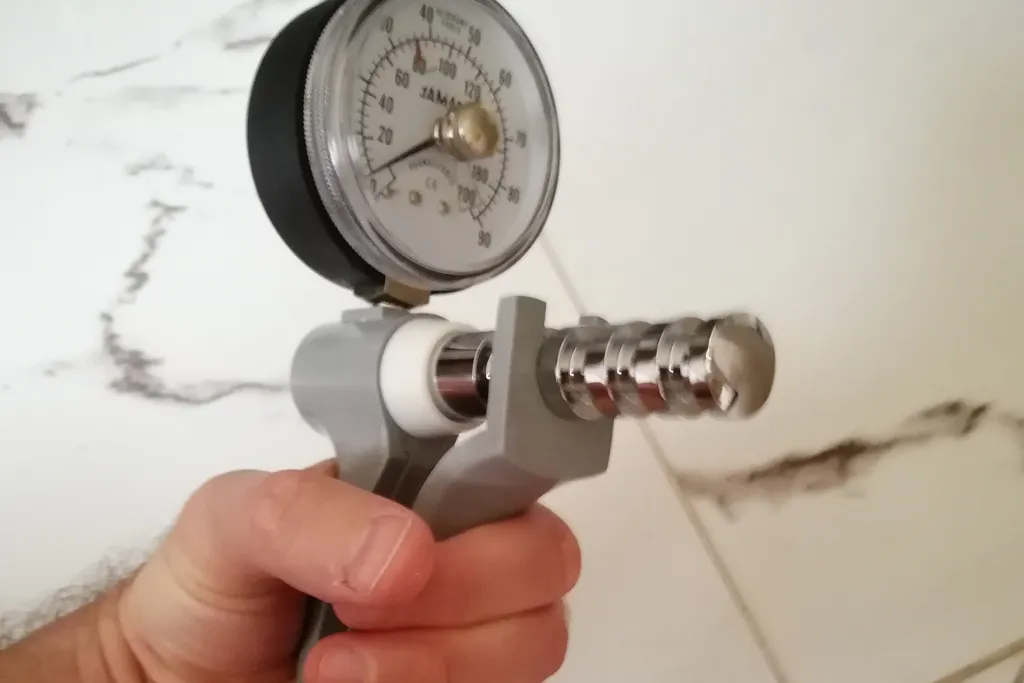
EWGSOP2 asks for a calibrated dynamometer, well-defined test conditions and comparison with an appropriate reference population, and cites the Jamar dynamometer as the most widely used and validated (Cruz-Jentoft et al., 2019). Roberts et al. (2011) showed that studies vary widely in position, number of attempts and which value to use, and proposed a standardized protocol. The key points, as described by those who apply this protocol (Villain et al., 2023):
- Client seated in a standard chair with a backrest and fixed armrests, always the same chair.
- Forearms resting on the armrests, wrist in neutral position or between 0° and 30° of extension, thumb up.
- Handle at position 2 of the Jamar for most hands.
- Attempts with both hands, alternating, recording the highest value.
Note the hand, handle position and device. At reassessment, repeat everything the same way.
Worked example
A 74-year-old woman, referred by her physician for strength training. At the assessment:
- SARC-F: 4 points. Positive screening.
- Handgrip strength: highest value 14.5 kg. Below 16 kg: low strength, probable sarcopenia.
- The muscle mass assessment by bioimpedance, done at the medical service, indicated ASM of 13.8 kg. Below 15 kg: with the low strength, sarcopenia confirmed by the EWGSOP2 criteria.
- Gait speed over 4 m: 0.7 m/s. Below 0.8 m/s: severe form by the criteria.
The assessor records the numbers and returns them to the physician. Their role is to measure well and track the progress of strength and performance with training.
Limits
- European cutoffs. The EWGSOP2 handgrip values rest on UK normative data. Because strength and gait speed depend on height, the consensus itself recommends using regional normative data when available (Cruz-Jentoft et al., 2019).
- Estimated muscle mass. Bioimpedance estimates muscle mass through equations, and the result depends on the device and the equation. See bioelectrical impedance: what it is and how it works.
- Handgrip protocol. Position, number of attempts and the value used change the result (Roberts et al., 2011). Compare only measurements taken the same way.
- The Lee equation is not ASM. The Lee equation estimates total skeletal muscle mass, not appendicular, and should not be compared with the cutoffs in the table.
For the other tests for older adults, see body assessment in older adults. To estimate maximal strength in people who train, see estimating 1RM. PounceFit for personal trainers stores each client's assessments and shows progress between them in charts.
Frequently asked questions
What is the handgrip strength cutoff for sarcopenia?
In EWGSOP2, handgrip strength below 27 kg in men and below 16 kg in women indicates low strength (Cruz-Jentoft et al., 2019). Low strength alone characterizes probable sarcopenia.
Is low strength already sarcopenia?
It is probable sarcopenia. To confirm, EWGSOP2 also asks for low muscle mass or quality, measured in clinical practice by DXA or bioimpedance. If physical performance is also low, sarcopenia is considered severe (Cruz-Jentoft et al., 2019).
Can a physical education professional diagnose sarcopenia?
The diagnosis is clinical. The assessor can apply the screening (SARC-F) and the strength and performance tests, record the results and refer to a physician when they are below the cutoffs.
Which dynamometer should I use?
EWGSOP2 cites the Jamar dynamometer as the validated and most widely used instrument, and asks for a calibrated device and well-defined test conditions (Cruz-Jentoft et al., 2019; Roberts et al., 2011). Always use the same device and protocol at reassessments.
Sources
- Cruz-Jentoft AJ, Bahat G, Bauer J, Boirie Y, Bruyère O, Cederholm T, et al. Sarcopenia: revised European consensus on definition and diagnosis. Age and Ageing. 2019;48(1):16-31. doi:10.1093/ageing/afy169
- Roberts HC, Denison HJ, Martin HJ, Patel HP, Syddall H, Cooper C, Sayer AA. A review of the measurement of grip strength in clinical and epidemiological studies: towards a standardised approach. Age and Ageing. 2011;40(4):423-429. doi:10.1093/ageing/afr051
- Malmstrom TK, Miller DK, Simonsick EM, Ferrucci L, Morley JE. SARC-F: a symptom score to predict persons with sarcopenia at risk for poor functional outcomes. Journal of Cachexia, Sarcopenia and Muscle. 2016;7(1):28-36. doi:10.1002/jcsm.12048
- Villain C, Lebaube S, Kremer C, Chavoix C, Fournel F, Briant AR, Beauplet B. Gripwise versus Jamar: the challenge of a new dynamometer assessing handgrip strength. Journals of Gerontology Series A. 2023;78(12):2458-2465. doi:10.1093/gerona/glad198