 PounceFit
 PT
 EN

Technical content for health and fitness professionals. It reproduces formulas and protocols published in the scientific literature, with the sources at the end of the page. It is not a recommendation and does not replace the judgment of the professional who runs the assessment.
In a body assessment, blood pressure is measured with the client seated for at least 5 minutes, using a validated device and a cuff sized to the arm, taking three measurements 1 minute apart and using the average of the last two (Brandão et al., 2025). Under the 2025 Brazilian Hypertension Guideline, normal pressure is below 120/80 mmHg, 120/80 to 139/89 is prehypertension and 140/90 or higher is the hypertension range. The assessor measures and refers: the diagnosis of hypertension is medical and requires repeated measurements at more than one visit.
Preparing the client before measuring blood pressure
The guideline lists the conditions for measurement in the office (Brandão et al., 2025, figure 3.1). Agree on them with the client when booking the assessment:
- 30 minutes without smoking and without eating or drinking caffeinated beverages.
- 90 minutes without exercise. Measure before any exercise test, never after.
- Empty bladder.
- Quiet room at a comfortable temperature.
- Seated for at least 5 minutes, back supported, legs uncrossed and feet on the floor, without talking.
- Arm bare, supported at heart level, palm facing up.
How to measure, step by step
- Device. Use a validated, calibrated device, preferably oscillometric (automatic). Calibration should be checked at least once a year (Brandão et al., 2025).
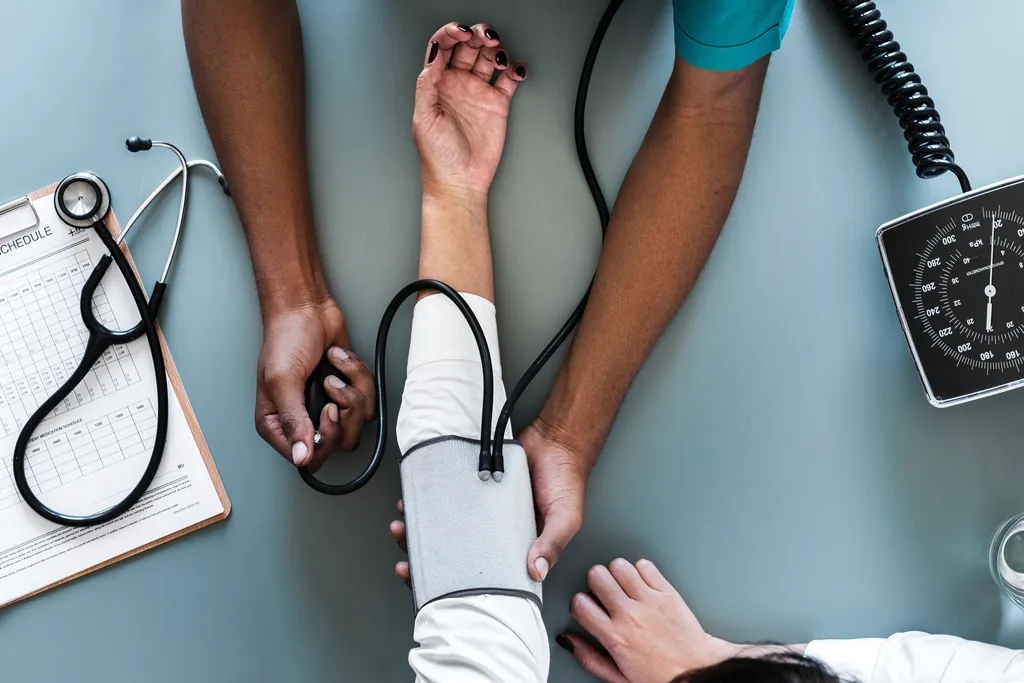
- Cuff. Choose the size that fits the arm. A cuff that is too small or too large over- or underestimates pressure. Apply it snugly, 2 to 3 cm above the elbow crease, with the middle of the bladder over the brachial artery.
- Both arms the first time. At the first assessment, measure both arms and from then on use the one that gave the higher value. A systolic difference of more than 15 mmHg between arms suggests increased cardiovascular risk and should be reported to the physician.
- Three measurements. Take three measurements 1 minute apart and record the average of the last two. If they differ by more than 10 mmHg, take additional measurements (Brandão et al., 2025, box 3.1).
- Older adults and other cases. In older adults, people with diabetes or dysautonomia, or people taking blood pressure medication, also measure lying down and 1 and 3 minutes after standing. A drop of 20 mmHg or more in systolic or 10 mmHg or more in diastolic defines orthostatic hypotension (Brandão et al., 2025).
With a manual device (auscultatory technique), the guideline also asks you to estimate the systolic level, inflate 20 to 30 mmHg above it and deflate slowly, about 2 mmHg per second. Systolic is the first sound and diastolic is when the sounds disappear (Brandão et al., 2025, box 3.1).
Blood pressure classification table
Classification by office measurement, from age 18 (Brandão et al., 2025, box 3.2):
| Classification | Systolic (mmHg) | Diastolic (mmHg) | |
|---|---|---|---|
| Normal | less than 120 | and | less than 80 |
| Prehypertension | 120 to 139 | and/or | 80 to 89 |
| Stage 1 hypertension | 140 to 159 | and/or | 90 to 99 |
| Stage 2 hypertension | 160 to 179 | and/or | 100 to 109 |
| Stage 3 hypertension | 180 or more | and/or | 110 or more |
When systolic and diastolic fall in different ranges, the higher one applies. The 2025 guideline dropped the "optimal pressure" category and now calls values of 120 to 129 systolic or 80 to 84 diastolic prehypertension, which were previously considered normal (Brandão et al., 2025).
When to refer and when not to train
The table classifies but does not diagnose. The guideline asks for repeated measurements at two or more medical visits, days or weeks apart, or measurement outside the office (ABPM or HBPM), to confirm hypertension (Brandão et al., 2025). In the assessor's practice:
- Normal: record it and continue the assessment.
- Prehypertension: record it, inform the client and suggest follow-up with their physician as part of their routine.
- 140/90 or higher: refer to a physician for confirmation. If the client is already being treated for hypertension, inform the physician who follows them.
- Above 160/105: do not run the training session or an exercise test that day (Brandão et al., 2025, section 6.4) and refer.
- 180/110 or higher: the guideline uses this value as the reference for hypertensive crisis. With symptoms such as chest pain, shortness of breath, severe headache or neurological symptoms, the client needs emergency care (Brandão et al., 2025, chapter 11).
The guideline also says that for light to moderate activity in people without heart, kidney or cerebrovascular disease, prior medical evaluation is not mandatory. People with hypertension plus other conditions, cardiovascular symptoms, several risk factors, or who plan high-intensity or competitive activity should have a medical evaluation first. During aerobic exercise, intensity should be reduced if pressure goes above 180/105 mmHg (Brandão et al., 2025, section 6.4). This logic matches the ACSM screening, which considers symptoms, known disease, activity level and planned intensity (Riebe et al., 2015).
Worked example
A 45-year-old client at the first assessment, after 5 minutes seated. Right arm 134/86 and left arm 128/82 on the initial measurement: the right becomes the reference arm. Three measurements on the right arm, 1 minute apart:
- 1st measurement: 138/88 mmHg (discarded in the calculation).
- 2nd measurement: 132/86 mmHg.
- 3rd measurement: 130/84 mmHg.
- Average of the last two: systolic (132 + 130) ÷ 2 = 131 mmHg; diastolic (86 + 84) ÷ 2 = 85 mmHg.
- The measurements do not differ by more than 10 mmHg, so there is no need to measure again.
- 131/85 mmHg: prehypertension. The assessor records it, informs the client and suggests medical follow-up. There is no barrier to the training session.
Limits of the measurement in an assessment
- One visit does not settle a diagnosis. The white coat effect can raise pressure at the time of the assessment, and the opposite effect also exists (Brandão et al., 2025). That is why the assessor's measurement is a signal to refer, not a label.
- Technique and device. The wrong cuff, an unsupported arm, talking during the measurement and a non-validated device change the result.
- Under 18. The table above applies from age 18. Children and adolescents have their own classification: from 1 to 12 years, by percentiles of sex, age and height; from 13 years, with fixed cutoffs lower than the adult ones (stage 1 hypertension from 130/80 mmHg) (Brandão et al., 2025, table 9.1).
Blood pressure is one of the resting measurements of a complete body assessment and comes after PAR-Q+ and health history screening. For aerobic prescription, see max heart rate and heart rate reserve. The printable body assessment form has a field for blood pressure, and PounceFit, body assessment software records resting blood pressure and heart rate in each assessment.
Frequently asked questions
Is 120 over 80 normal blood pressure?
Under the 2025 Brazilian Hypertension Guideline, 120/80 is no longer normal. Normal pressure is systolic below 120 and diastolic below 80 mmHg. Values of 120 to 139 systolic or 80 to 89 diastolic are now classified as prehypertension (Brandão et al., 2025).
Can a personal trainer diagnose hypertension?
No. Diagnosis requires repeated measurements at two or more medical visits, days or weeks apart, or measurement outside the office (ABPM or HBPM) (Brandão et al., 2025). In a body assessment, the professional measures, records and refers when the value is abnormal.
At what blood pressure should a client not train?
The Brazilian guideline advises not doing the training session if pressure is above 160/105 mmHg, and lowering intensity if it goes above 180/105 mmHg during aerobic exercise (Brandão et al., 2025).
Which arm should I use to measure blood pressure?
Both arms the first time. After that, the arm that gave the higher pressure. A systolic difference of more than 15 mmHg between arms suggests increased cardiovascular risk (Brandão et al., 2025).
Can I measure right after a workout?
Not for the resting measurement. The guideline asks for 90 minutes without exercise and 30 minutes without smoking, eating or drinking coffee before the measurement (Brandão et al., 2025).
Sources
- Brandão AA, Rodrigues CIS, Bortolotto LA, Armstrong AC, Mulinari RA, Feitosa ADM, et al. Diretriz Brasileira de Hipertensão Arterial - 2025. Arquivos Brasileiros de Cardiologia. 2025;122(9):e20250624. doi:10.36660/abc.20250624
- Riebe D, Franklin BA, Thompson PD, Garber CE, Whitfield GP, Magal M, Pescatello LS. Updating ACSM's recommendations for exercise preparticipation health screening. Medicine and Science in Sports and Exercise. 2015;47(11):2473-2479. doi:10.1249/MSS.0000000000000664